
Balochistan produces about a fifth of Pakistan's natural gas, yet in the 2023 census a smaller share of its households cooked with gas than in any other province. Most of the province's households that cook mainly with gas are in Quetta. There, 85.1 per cent of households cook mainly with gas. In the rest of the province the figure is 8.3 per cent.
What Balochistan receives for what leaves its ground is a long-running argument. Official records, with reporting from the gas fields, can answer part of it: who uses the gas, what the provincial government receives directly, and whether recorded mineral output matches exports. Supply from the province's gas fields fell by 28 per cent between 2018-19 and 2024-25, its recorded chromite output reached a high in 2023-24, and Reko Diq, the copper and gold project from which the budget expects higher royalties, has been slowed pending a review to mid-2027.
Most of the province's gas-cooking households are in Quetta
Figure 1 shows the share of households cooking mainly with gas, in towns and villages, by province and for Quetta and the rest of Balochistan.
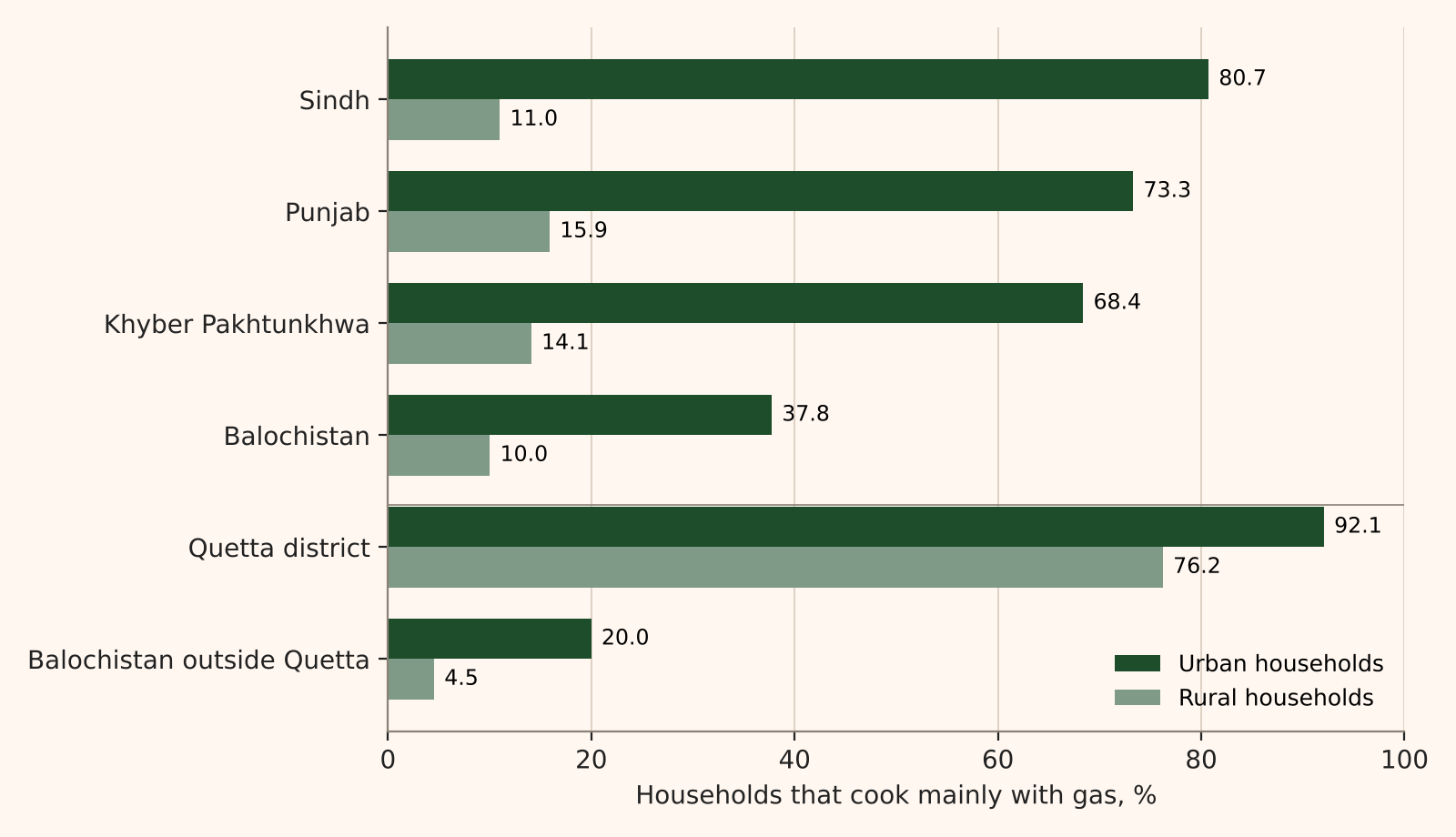
In 2023, 17.9 per cent of Balochistan's households cooked mainly with gas, against 47.4 per cent in Sindh, 39.4 per cent in Punjab and 22.6 per cent in Khyber Pakhtunkhwa. Fewer of its households live in towns (28 per cent, against 52 per cent in Sindh), and rural households everywhere rarely cook with gas. In rural areas Balochistan is close to the other provinces, at 10.0 per cent against 11.0 in Sindh and 15.9 in Punjab. In towns it is far behind, at 37.8 per cent against 80.7 in Sindh and 73.3 in Punjab.
Quetta holds 59 per cent of the province's gas-cooking households. Outside Quetta, 20.0 per cent of urban households and 4.5 per cent of rural ones cook with gas.
The tehsils of Dera Bugti district that contain its gas fields vary widely. In Sui, 42.7 per cent of households cook with gas, more than twice the provincial average. In Pir Koh the share is 14.7 per cent, and in Loti it is 0.2 per cent.
The census records the fuel a household mainly uses, not connection, reliability or cost. Adaad spoke to two long-term residents of the gas-field areas and to an official of Sui Southern Gas Company (SSGC), which distributes gas in the province. All asked not to be named. The official said SSGC does not supply homes in Loti or Pir Koh, although pipelines were laid in Pir Koh about 30 years ago, citing scattered settlements, terrain, security and falling output. In Sui, by the official's own estimate, 8,000 to 10,000 homes have connections, unmetered and free, supplied at set hours. The official did not define the area that estimate covers.
A resident of a settlement near the Zain Koh–Loti field said most households within about a kilometre of it have connections they laid to the main pipeline themselves and maintain at their own cost. Pressure is low, the exposed pipes break, and when supply fails households burn firewood, as do those living further away. How his settlement relates to the census tehsil, where 0.2 per cent of households cook with gas, is not established. A resident of Pir Koh said his household has no connection, cooks with firewood bought locally, and has seen little change in recent years.
The province's share of estimated gas payments usually trails its share of output
The province receives royalty on its gas, at 12.5 per cent of wellhead value, a share of the gas development surcharge collected through consumer prices, and a small excise duty. Under the 2010 National Finance Commission award, royalty and surcharge are notionally combined into an average rate per unit of energy (MMBTU), and the surcharge is distributed on that basis. An informative starting point is to compare Balochistan's share of the combined payments with its share of gas production by volume, as Figure 2 does. The formula works in energy units, which vary between fields, and budget estimates may not match the timing of the gas, so the comparison raises a question but does not calculate a shortfall.
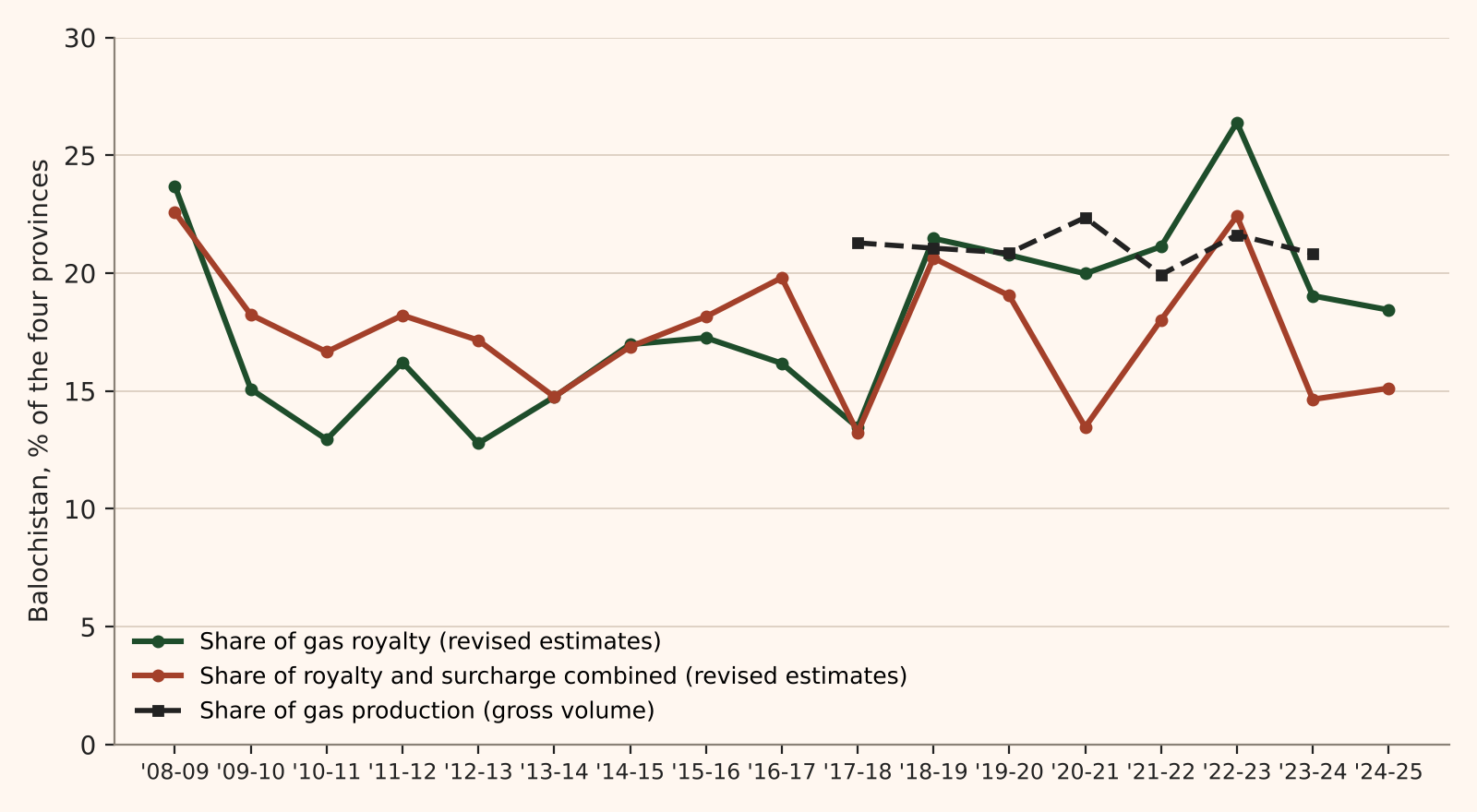
From 2017-18 to 2023-24, Balochistan produced between 19.9 and 22.4 per cent of the four provinces' gas. Its share of combined royalty and surcharge in the revised estimates was below its production share in six of those seven years. In 2023-24 the revised estimates allocated it 14.7 per cent of the combined payments, while it produced 20.8 per cent of the gas. Its royalty share on its own was closer to its production share, at 19.0 per cent, so most of the difference came from the surcharge.
In the revised estimates, the surcharge ranged from Rs 4.5bn to Rs 6.5bn a year between 2008-09 and 2015-16, rose to Rs 13.8bn in 2016-17, then fell to no more than Rs 2.9bn a year from 2017-18 to 2023-24. It was nil in 2020-21 and 2023-24.
The province's 2025-26 budget white paper records Rs 38.5bn in the 2024-25 revised estimates on a line headed "Non-Dev Grants / GDS Arrears". The following year's budget statement records Rs 38.9bn under the same grants account as the 2024-25 actual figure, with the ordinary surcharge listed separately. Neither shows how much was surcharge arrears, which years they covered, or how much of any amount owed was settled. These comparisons are a reason to reconcile the accounts, not proof that Balochistan was underpaid.
The selected transfer and departmental receipt lines, oil and gas straight transfers and the Mineral Resources Department's receipts, came to 4.1 per cent of provincial receipts in the revised estimates for 2024-25 and 2025-26. A Rs 41.2bn bonus for extending the Sui lease would alone take 2024-25 to about 8.7 per cent, and the combined grants line cannot be allocated. None of these figures measures how much of the value of the gas and minerals stays in the province.
Basic service gaps remain in producing districts
Seven districts outside Quetta either produced at least 100,000 tonnes of minerals in the provincial mines department's latest table or contain the main gas fields: Chagai, Dera Bugti, Duki, Harnai, Khuzdar, Lasbela and Qila Saifullah. Figure 3 shows, for their populated villages (mouzas) in the 2020 Mouza Census, the share where electricity was available to none of the inhabitants and the share reporting solar.
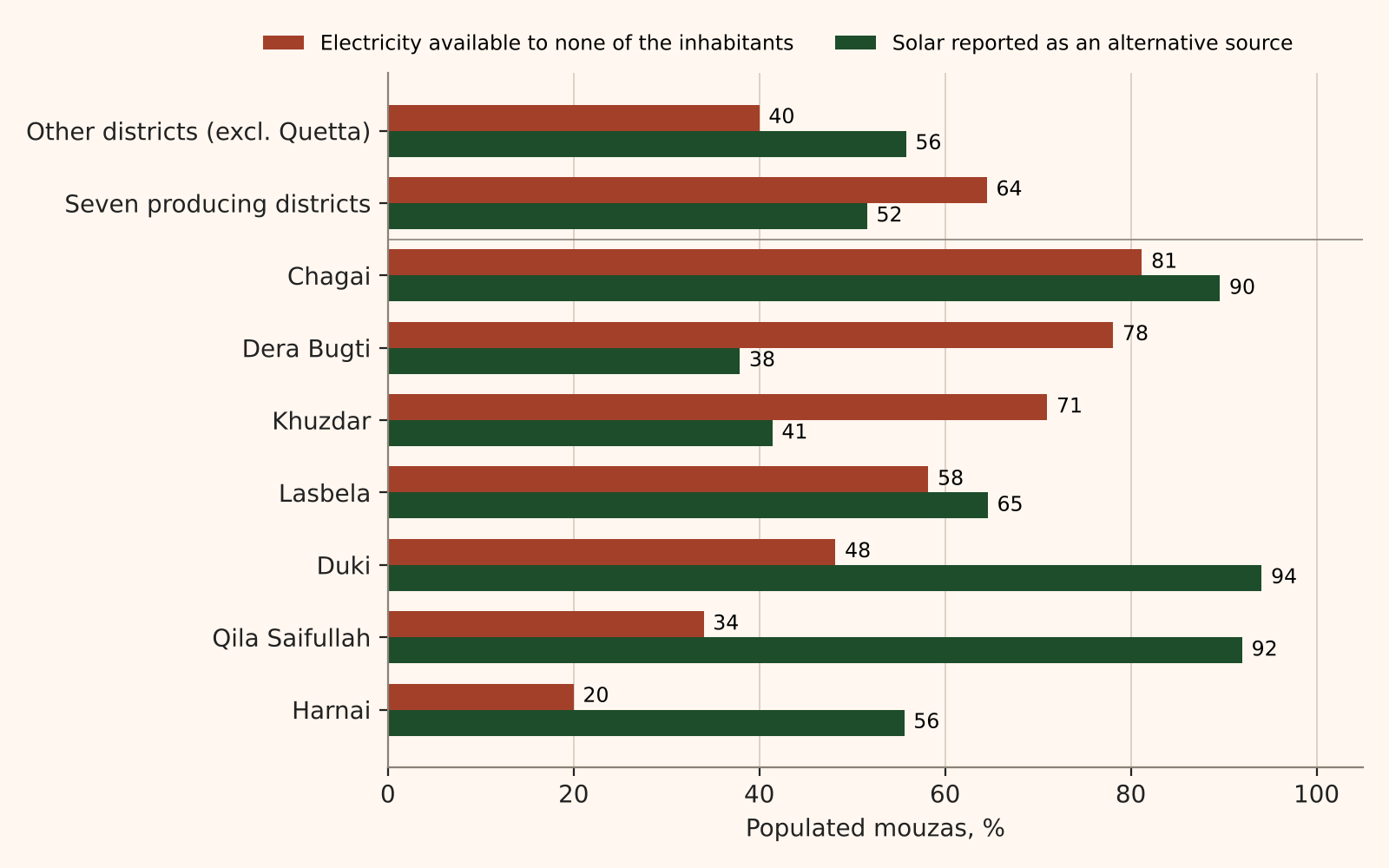
In 64 per cent of populated mouzas in the producing districts, electricity was available to none of the inhabitants, against 40 per cent elsewhere, a gap that holds under broader definitions of a producing district. Among the producing districts' mouzas with no electricity available, 37 per cent reported solar as an alternative, so solar fills part of the gap. In Chagai, home of the Saindak and Reko Diq projects, 81 per cent of mouzas reported no available electricity, and 87 per cent of those reported solar. These are shares of villages, not of households or of electricity needs met.
In Dera Bugti, home of the Sui field, solar fills less of the gap. In 78 per cent of its mouzas electricity was available to none of the inhabitants, and only 32 per cent of those reported solar. Its literacy rate, 24 per cent, is the third lowest of the 34 districts with a figure, although literacy across the producing districts as a group does not differ consistently from the rest of the province.
These are present differences, not effects of extraction. The minerals lie in remote places where services are thin for many reasons. Mining employs about 40,000 people, 1.1 to 1.3 per cent of the province's workers.
Chromite exports exceed recorded production
Chromite, the ore from which chromium is made, is the clearest accounting anomaly in these records, and it is a national one. In the five years from 2019-20 to 2023-24, the only recent run with complete import records, Pakistan exported 1.91 million tonnes of chromite. It recorded producing 0.86 million tonnes and importing 84,331 tonnes, mostly from Afghanistan in 2021-22 and 2022-23. That leaves 0.96 million tonnes, about half of exports in those years, not accounted for by recorded production or imports. Balochistan is the largest recorded producer, mostly from Muslim Bagh in Qila Saifullah district, with 72 per cent of Pakistan's recorded output in 2023-24. Figure 4 sets recorded production and imports against exports over a longer period.
In each of the 22 years from 2002-03 to 2023-24, Pakistan's chromite exports were between 1.4 and 5.6 times its recorded production. Exports totalled 7.2 million tonnes and recorded production 2.7 million. Import files from the Pakistan Bureau of Statistics (PBS) are missing in our compilation for six of those years, and Pakistan's own reports to the UN for the overlapping calendar years show small imports.
The gap has been noticed before. A 2012 study by the Small and Medium Enterprises Development Authority (SMEDA) said chromite production was not correctly reported, citing exports of 45,955 tonnes against recorded production of 24,484 in 1992-93. Global Witness put Pakistan's 2016 production at about 230,000 tonnes against exports of almost 350,000, and suggested the difference was mined in Afghanistan. Neither reconciled the records over a run of years.
China's records corroborate the shipments: 429,750 tonnes of chromium ore from Pakistan in 2023, close to the 427,507 tonnes Pakistan reported sending. That does not establish where the ore was mined. China records almost no chromite arriving directly from Afghanistan, and our query of the UN database returned no Afghan-reported chromite export observations for 2003 to 2025.
The records cannot separate the possible explanations: ore mined in Pakistan but missing from the production statistics, unrecorded ore from across the border, or stocks built up before 2002-03, which would have to be large to supply the gap for 22 years. Balochistan's share of recorded output does not give its share of the unrecorded tonnage, and the gap does not show that royalty went unpaid. Over the years analysed, the province's 2002 mineral rules charged royalty on minerals sold, processed or exported, required returns of production and disposal, and provided for dispatch slips, so ore missing from the production statistics could still have been assessed. The royalties actually assessed and collected on chromite are not in the records we hold.
What the records show
The clearest findings are the household contrast and the chromite balance. Outside Quetta, fewer than one household in ten cooks mainly with the gas the province produces, and in the five years with complete records about half of Pakistan's chromite exports cannot be matched to recorded production or imports. Villages in the producing districts more often lack electricity. The budget estimates allocate Balochistan a smaller share of gas payments than of output, a question for the accounts rather than a measured shortfall.
None of these findings has yet been put to the institutions that could explain them: PBS and the provincial mines department on the chromite balance and royalty, the federal and provincial finance departments on the gas payments and the grants line, and SSGC on its service in Dera Bugti. The SSGC figures above are one official's own estimates, not the company's. Any responses will be added to this page with a dated note.
Reko Diq's royalties and taxes are set by its own mineral agreement, and the provincial government holds 25 per cent of the project company. Assessing the province's returns from it, as from chromite and gas, requires production and payment records that can be reconciled: dispatch and royalty records for chromite, and gas entitlement and release records for the surcharge. Those records would show whether the province is paid what the formulas imply. They would not show who in Dera Bugti, which has supplied Pakistan's gas since the 1950s, gets to cook with it. The resident near the Zain Koh–Loti field maintains his own connection to the pipeline. The resident of Pir Koh still cooks with firewood.
Reporting. Adaad interviewed two residents of Dera Bugti district, near the Zain Koh–Loti field and in Pir Koh, and an SSGC official, in November 2026. Respondents are not named at their request. The official's connection and coverage figures are personal estimates, and the relationship between the residents' settlements and the census tehsils has not been verified. PBS, the Balochistan Mines and Minerals Development Department, the federal and provincial finance departments and SSGC (as an institution) were not asked for comment before publication, so the article reports the records and accounts without their explanations. The questions to be put to them are the composition of the chromite residual and the royalty assessed on it, the gas entitlement and release reconciliation and the make-up of the grants line, and SSGC's service area, connection count and metering in Dera Bugti district.
Records used. The 2023 census, federal and provincial budget documents, PBS minerals production and trade data, the Oil and Gas Regulatory Authority's (OGRA) State of the Regulated Petroleum Industry, the Mouza Census 2020, the Labour Force Survey and UN Comtrade.
Household gas. The census reports each household's main cooking fuel. Gas excludes LPG and LNG cylinders. Urban and rural follow the census classification. Tehsil figures are from the census tehsil tables for Dera Bugti district. In the census lighting question, "electricity" and "solar panel" are separate categories; in Loti, 92.8 per cent of households report another main source of light.
Gas supply and production. Supply from Balochistan's fields is from OGRA's field-wise supply tables (656 to 473 million cubic feet a day, 2018-19 to 2024-25). Production shares in Figure 2 use PBS gross production of natural gas by province (2017-18 to 2023-24), which differs in definition from OGRA's supply figures. Provincial volumes before 2017-18 are not held in our compilation.
Gas payments. Under the 2010 award, the surcharge is distributed after a 2 per cent collection charge. Royalty and surcharge are the revised estimates for each year published in the following year's federal budget (Explanatory Memorandum on Federal Receipts), not audited releases. The comparison uses gas volume, not energy content, and does not adjust for timing. Balochistan's share of combined royalty and surcharge in the revised estimates, against its PBS production share, was 13.2 against 21.3 per cent in 2017-18, 20.6 against 21.1 in 2018-19, 19.0 against 20.9 in 2019-20, 13.5 against 22.4 in 2020-21, 18.0 against 19.9 in 2021-22, 22.4 against 21.6 in 2022-23 and 14.7 against 20.8 in 2023-24.
Provincial receipts. For 2024-25 (revised), the source is the Government of Balochistan's Budget White Paper 2025-26: total receipts from Table 1 (PDF page 7); straight transfers, the PPL lease bonus and the "Non-Dev Grants / GDS Arrears" line from Table 2 (page 9); Mines and Mineral Department receipts from Table 6 (page 14). The selected lines are Rs 37.03bn of Rs 894.26bn (4.1 per cent); adding the Rs 41.2bn lease bonus gives Rs 78.23bn (8.7 per cent). The Rs 38.5bn mixed line is not allocated in either figure. In the province's Annual Budget Statements it is account C03604, Other Grants from Federal Government (Non-Development): Rs 38.5bn in the 2024-25 revised estimate (Annual Budget Statement 2025-26) and Rs 38.901bn in the 2024-25 actual accounts (Annual Budget Statement 2026-27). The ordinary surcharge is account C03904, with a 2024-25 revised estimate of Rs 2.352bn. All receipts figures in the text are revised estimates except the Rs 38.9bn, which is an actual. For 2025-26 (revised), the source is the Budget White Paper 2026-27: total receipts and straight transfers from Table 1 (page 16) and Mineral Resources Department receipts from Table 3 (page 27). The selected lines are Rs 36.4bn of Rs 886.7bn; including the Rs 0.37bn lease bonus received that year gives 4.15 per cent. Straight transfers include royalty on crude oil, which is small for Balochistan.
Chromite trade. Exports and imports are PBS eight-digit trade records for HS 2610 (chromium ores and concentrates), main section only. The PBS import files in our compilation are missing for 2008-09 to 2012-13 and 2018-19, and the import-adjusted balance uses only the five fiscal years with complete files; Figure 4 marks the missing years rather than counting them as zero. Pakistan's annual import reports to UN Comtrade (Pakistan as reporter, world as partner, net weight) were queried for each calendar year from 2003 to 2025 on 25 October 2026. For the calendar years overlapping the missing fiscal years they show 860 tonnes (2008), 397 (2009), 161 (2010), 102 (2011), 2,476 (2012), 741 (2013), 377 (2018) and 378 (2019). These figures are not added to the fiscal-year balance. Afghanistan as reporter returned no chromite export observations for any year, although it returned total-export observations for 2008 and 2018. China's imports are from UN Comtrade (China as reporter, Pakistan as partner, net weight).
Chromite production. Production is the PBS provincial sum from PBS's compilation workbook (2002-03 to 2022-23) and the 2023-24 release. It generally agrees with the Economic Survey's national series: 20 of 22 years are within 1 per cent. The exceptions are 2002-03 (PBS 25,232 tonnes, Survey 31,000) and 2004-05 (PBS 86,359, Survey 56,000); exports exceed production in both years on either figure. PBS is used because it gives provincial and monthly detail in unrounded tonnes. It matches the Balochistan Bureau of Statistics' district series where the two overlap. All three rest on the provincial mines departments' returns.
Royalty. The description applies to the period analysed. The Balochistan Mineral Rules, 2002 charged royalty at rates the government notified (rule 102) on minerals disposed of (rules 101–102), required production and disposal records and returns (rules 56 and 104), and provided for transport checks and dispatch slips (rule 119). The Balochistan Mines and Minerals Act, 2025 supersedes that framework, with savings for existing arrangements in section 122; the provincial government said in September 2025 that it had suspended the Act's implementation pending review, and challenges to it are before the Balochistan High Court. How existing chromite titles are treated under it has not been checked here. A September 2017 notification revised royalty rates; the Supreme Court held in 2024 that it took effect only from the provincial cabinet's approval on 1 February 2022 (Government of Balochistan v Attock Cement Pakistan Ltd, 2024 SCMR 876). Royalty assessed and collected on chromite is not in our records.
Earlier work. SMEDA (2012), section 4.1, p. 7; Global Witness (2018), p. 42. Five other studies of chromite mining, processing and trade in Pakistan were checked and do not compare production with exports.
Which districts. Producing districts are those credited with at least 100,000 tonnes of output in the Balochistan Mines and Minerals Development Department's production table (page created March 2025, period not stated), plus Dera Bugti for gas. Quetta, which meets the threshold through coal, is excluded as the provincial capital. Hub is counted with Lasbela, its parent district. Output listed for "Chamalang" is not assigned, because the coalfield spans Loralai, Kohlu and Barkhan districts.
Village electricity. Mouza Census 2020 microdata, Part VI. Question 1 asks whether electricity is available to all, most, some or none of a mouza's inhabitants; question 2 records alternative sources (solar, biogas, generator, other, none). The universe is populated mouzas included in the analysis (population-status codes 1 to 3): 2,186 in the producing districts and 4,485 in the other districts, excluding Quetta. Shares for question 1 use valid answers only (two missing answers in the producing districts). Solar shares use mouzas answering question 2. Among mouzas with no electricity available, 37 per cent in the producing districts and 44 per cent elsewhere reported solar. Under broader definitions the gap persists: 63 against 40 per cent including Quetta, 62 against 39 per cent counting all named districts except Quetta (adding Kachhi and Kohlu), and 60 against 39 per cent counting all of them.
Literacy. District literacy rates are from the Balochistan Bureau of Statistics (2025). Weighted by 2023 population, the seven producing districts average 35.6 per cent against 40.0 per cent, but the medians are 36.5 against 38.6 per cent, including Quetta raises the producing average to 45.2 per cent, and counting all 11 districts named in the department's table reverses the medians (38.6 against 37.0 per cent). The group comparison is therefore not used.
Jobs. Labour Force Survey 2020-21 and 2024-25 microdata. The 2024-25 estimate rests on 133 sampled mining workers in Balochistan.
Files. The numbers behind the four figures, the village electricity tables by district and the chromite balance by year are downloadable below.
Sources
Barrick Gold (2026). Barrick provides an update on Reko Diq, 2 April 2026; and Reko Diq Project technical report, effective 31 December 2024.
Finance Department, Government of Balochistan. Budget White Paper 2025-26 and Budget White Paper 2026-27.
Finance Division, Government of Pakistan. Explanatory Memorandum on Federal Receipts, budgets 2009-10 to 2026-27, including the provisions of the 2010 NFC award.
Oil and Gas Regulatory Authority. State of the Regulated Petroleum Industry, 2019-20 to 2024-25.
Pakistan Bureau of Statistics. Minerals Production Data, 2002-03 to 2023-24; External Trade Statistics by commodity and country; Population and Housing Census 2023, Table 22; Labour Force Survey 2020-21 and 2024-25; Mouza Census 2020.
Ministry of Finance. Pakistan Economic Survey, Statistical Supplement, Table 3.1A.
Balochistan Bureau of Statistics. District indicators.
Mines and Minerals Development Department, Government of Balochistan. Production of minerals by district.
Global Witness (2018). “At any price we will take the mines”: the Islamic State, the Taliban, and Afghanistan's white talc mountains. May 2018.
Small and Medium Enterprises Development Authority (2012). Pre-feasibility study: chromite beneficiation plant. SMEDA Balochistan, March 2012.
Supreme Court of Pakistan (2024). Government of Balochistan v Attock Cement Pakistan Ltd, 2024 SCMR 876.
Government of Balochistan. Balochistan Mineral Rules, 2002; Balochistan Mines and Minerals Act, 2025; Annual Budget Statement 2025-26 and Annual Budget Statement 2026-27.
The Express Tribune (2025). Balochistan suspends Mines Act, 24 September 2025.
United Nations. UN Comtrade Database, HS 2610, China, Pakistan and Afghanistan.
Data and methods downloads
- Figure 1 data: cooking with gas, urban and rural (CSV)
- Figure 2 data: gas payment and production shares by year (CSV)
- Figure 3 data: village electricity and solar by district and tehsil (CSV)
- Village electricity under other definitions of a producing district (CSV)
- Figure 4 data: chromite production, imports and exports by year (CSV)
- Census 2023, Table 22 (PBS) ↗
- PBS Minerals Production Data ↗
- Mouza Census 2020 (PBS) ↗
- Balochistan Budget White Paper 2025-26 ↗
- UN Comtrade ↗
- Source and method notes (Markdown)