
Adaad · Volume 1, Issue 1 · Friday 14 August 2026 · Launch issue
Data Darbar ↗ Aiwan-e-Jamhoor ↗ CoverContents Archive About
Volume 1 · Issue 1 · Launch A data journal of Pakistan
Key numbers in this issue
Output per worker−2.5%
FY21–FY25 · Adaad estimate
Remittances, FY26$41.6bn
1.35× goods exports
Informal employment80.8%
LFS 2024-25
Poverty headcount28.9%
Economic Survey FY26
EconomyThe big read

Growth without an engine

Export-led growth is the right ambition, but the engine that will deliver it never gets built. Two new household surveys show why.

Figure 1 · Diverging bars
More people, not more output per person
Cumulative change FY21–FY25, per cent. The engine — output per worker — is running backwards.
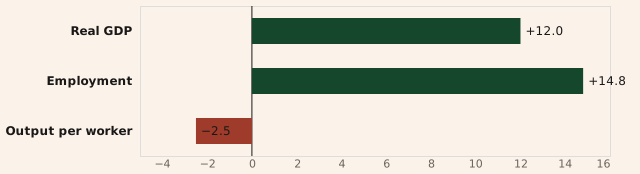
Cumulative change FY21 to FY25: real GDP up 12 per cent, employment up 14.8, output per worker down 2.5
Growing Falling PBS national accounts and LFS benchmarks via Data Darbar

Growth has been here before — 5.8 per cent in FY21, 6.2 in FY22 — and both times it was gone within a year. The two charts above are the same story told twice: an expansion powered entirely by more people working, and what happens to expansions like that.

Read the lead story
Featured this issue
FeatureWorkforce
Counting women in

Female participation is rising in rural and urban areas alike, and education is not what pulls. In urban areas every group joined except the most educated: graduate participation has not moved in four years.

2020–21 2024–25 0102030 Less than primary Primary Middle Matric Intermediate Degree or higher
Urban women aged 15–64: participation by education level, LFS 2020–21 to 2024–25. An Adaad estimate from the PBS microdata.
Read the story
PlotlineTrade
Pakistan's biggest export is Pakistanis

Goods exports and remittances tracked each other from 2018 to 2024. Then they diverged: exports stood still but remittances did not.

203040 FY18FY19FY20FY21FY22FY23FY24FY25FY26 Remittances Goods exports
$ billion, by fiscal year. SBP balance of payments; PBS trade statistics. Hover a year.
Read Plotline
Companions to the journal
Economic and social indicators
Data Darbar
Pakistan in numbers

The indicator library Adaad's charts are built from — census, 8-digit trade, national accounts and the federal budget, mapped and traceable to source.

Open Data Darbar ↗
New in Data Darbar
Changed 23 Aug 2026
The Survey Vintage layer is retired
It told a reader which survey year a district's figure came from, which is a property of the indicator rather than of the district, and it belonged in the notes rather than on the map.
New 22 Aug 2026
The Mouza Census 2020 is on the map
Rural facilities for every tehsil, which is why the map is now District & Tehsil rather than district only. The mouza is the rural revenue unit, and the explainer that says so opens before any mouza statistic is shown.
All additions and corrections →
Electoral data and analysis
Aiwan-e-Jamhoor
The people's house

Eleven general elections, 1977–2024, drawn on the constituency boundaries in force at the time — every seat, every candidate, every vote count.

Open Aiwan-e-Jamhoor ↗
New in Aiwan-e-Jamhoor
New 12 Aug 2026
Islam & Politics
The religious vote from 1988 to 2024, by sect and by seat, with the map beside it. Religio-political parties took 11.9 per cent of the 2024 vote without an alliance or a patron and returned seven members, and the page is about where the two numbers come apart.
New 12 Aug 2026
Candidate linkage extended back to 1977
The new Overview follows cohorts rather than elections: how many of the members first returned in a given year were still winning ten and twenty years later. Survival and re-election use different denominators, and the page now says which is which.
All additions and corrections →
The Adaad Letter
The whole issue, in your inbox. Once a month.

A short, thoughtful reading of the numbers shaping Pakistan. Issue 2 lands 16 September.

One issue a month. Unsubscribe in one click.